Updated: July 2026
Komodo vs Raja Ampat: Best for a Luxury Phinisi Cruise
- Choose Komodo for: Iconic wildlife (dragons), striking savannah-like scenery, and shorter, action-packed itineraries.
- Choose Raja Ampat for: World-class diving, kaleidoscopic coral reefs, and longer, more immersive journeys into pristine nature.
- Consider the Season: Komodo’s prime season is April to October, while Raja Ampat is best from October to April.
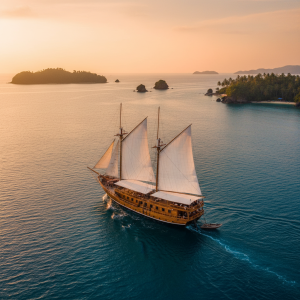
The sun is high, warming the hand-sanded ironwood of the deck beneath your feet. The ship’s seven sails, a brilliant tan against the sapphire sky, are full. You hear nothing but the gentle creak of the rigging and the sound of the sea parting before the bow. This is the essence of a luxury phinisi cruise, an immersion into a world governed by wind and tide. But as you sail through the Indonesian archipelago, the ultimate question arises for the discerning traveler: which maritime realm to conquer? Is it the raw, prehistoric world of Komodo, or the sublime, aquatic Eden of Raja Ampat? As a travel editor who has spent considerable time navigating these waters, I can tell you the answer isn’t about which is better, but which is intrinsically, perfectly *you*.
The Lay of the Land: Contrasting Topographies
The first and most striking difference between these two destinations is the very earth beneath your feet and the islands that rise from the sea. They are two distinct, powerful expressions of Indonesia’s geological soul. Komodo, part of the Lesser Sunda Islands, feels ancient and formidable. It is a world shaped by fire and drought. The islands of the Komodo National Park, a UNESCO World Heritage site covering 1,733 square kilometers, are volcanic and rugged. During the dry season (typically May through September), the hills are draped in a burnished gold savannah, punctuated by the skeletal forms of lontar palms. It’s a stark, dramatic beauty that feels almost African, a landscape that seems perfectly suited to the primeval dragons that roam it. The powerful currents that churn through the Sape Strait have carved these islands into muscular shapes, creating a sense of raw, untamed power. Sailing here feels like navigating through a lost world, where every cove reveals another starkly beautiful, sun-scorched vista.
Raja Ampat, by contrast, is a world of water and life. Located off the coast of West Papua, its name translates to “The Four Kings,” for the four main islands of Misool, Salawati, Batanta, and Waigeo. But the true majesty lies in the more than 1,500 jungle-draped karst islets that explode from the turquoise water. These limestone formations, eroded over millennia, create a labyrinth of hidden lagoons, secret channels, and secluded beaches that appear as if by magic. The landscape is soft, verdant, and teeming with life. Dense rainforest spills directly into the sea, and the air is thick with the scent of wet earth and tropical blossoms. It’s a far more intimate and serene environment than Komodo. Aboard your phinisi, you can spend days weaving through these island clusters without seeing another vessel, fostering a profound sense of discovery and seclusion across its vast 40,000-square-kilometer marine territory.
Below the Surface: A Diver’s Dilemma
For many who begin a luxury phinisi cruise, the world below the waves is the primary draw. Here, the choice between Komodo and Raja Ampat becomes a delightful debate between two world-class, yet fundamentally different, diving philosophies. Raja Ampat is, without hyperbole, the global epicenter of marine biodiversity. It sits at the heart of the Coral Triangle, a region that, according to Wikipedia, hosts more marine species than anywhere else on the planet. The sheer density and variety of life are staggering. Imagine descending onto a reef so vibrant it seems to pulsate, where 75% of the world’s known coral species thrive. On a single dive, you can witness colossal schools of barracuda, pygmy seahorses the size of a fingernail, graceful manta rays at cleaning stations, and camouflaged wobbegong sharks resting on the seafloor. With over 1,600 species of reef fish documented, it’s often called a “species factory” by marine biologists. The water is typically a placid 28-29°C, making for long, comfortable dives focused on exploration and underwater photography.
Komodo, however, is the champion of adrenaline. The diving here is defined by the powerful currents that surge between the Indian and Pacific Oceans. These currents can be challenging, but they bring with them an incredible amount of nutrients, attracting a profusion of large pelagic life. Sites like Castle Rock and Batu Bolong are legendary for their high-octane drift dives, where you hook into the reef and watch the spectacle unfold: whitetip and grey reef sharks patrolling the edges, giant trevallies hunting in unison, and enormous schools of fusiliers creating a river of silver. Komodo is also one of the most reliable places on earth to dive with majestic reef manta rays, particularly at the famed Manta Point. The water is slightly cooler, averaging 25-27°C, but the action is nonstop. It’s less about finding tiny, rare critters and more about experiencing the awesome power and scale of the ocean’s food chain in action.
Onshore Excursions: Dragons vs. Birds of Paradise
While the sea is the star, the adventures on land are equally compelling and distinct. In Komodo, the headline act is, of course, the Komodo dragon (Varanus komodoensis). Walking on the islands of Rinca or Komodo with a certified park ranger is a genuinely thrilling experience. There’s a palpable tension in the air as you track these formidable predators, which can reach 3 meters in length and weigh over 70 kilograms. It is a humbling, primeval encounter. Yet, Komodo’s onshore appeal extends beyond its famous reptile. The trek to the summit of Padar Island is an essential pilgrimage, rewarding you with an iconic panorama of three crescent bays, each with a different shade of sand—white, black, and a remarkable pink. Speaking of which, spending an afternoon on one of the Pink Beaches, colored by crushed red organ-pipe coral, is a surreal and beautiful experience, perfect for a gourmet beach barbecue arranged by your phinisi crew.
Raja Ampat’s land-based activities are more about immersion in a pristine, untouched ecosystem. The signature excursion involves a steep but rewarding climb up the karst formations of Wayag or Piaynemo to witness a view that has graced countless magazine covers—a sprawling seascape of mushroom-shaped islets set in a painter’s palette of blue and turquoise. The experience is one of profound tranquility and awe at nature’s artistry. Beyond these viewpoints, you can take a tender or kayak through silent, labyrinthine mangrove forests, their roots a nursery for juvenile fish. For the intrepid, early morning treks into the dense jungle on islands like Gam offer a chance to spot the rare and spectacular Red Bird-of-Paradise performing its elaborate courtship dance. You can also visit remote Papuan fishing villages, offering a respectful and authentic glimpse into a way of life that has remained unchanged for centuries.
The Journey Itself: Logistics and Seasonality
The practical aspects of planning your voyage are crucial and represent a significant point of differentiation. Komodo is the more accessible of the two. The gateway is the rapidly developing town of Labuan Bajo on Flores (LBJ), which is a short 1-hour flight from Bali (DPS). The cruising grounds of the national park are relatively compact, meaning you can experience the highlights—dragons, Padar Island, Manta Point—in a well-planned 5- to 7-night itinerary. This makes it an excellent choice for those combining their sail with a land-based Bali vacation or who have a more limited time frame. The crucial thing to remember is the seasonality. The best time to visit Komodo is during the dry season, from April to October, when the seas are generally calm and the weather is clear. You can learn more about this on our guide to the best time for a phinisi yacht charter.
Raja Ampat demands a greater commitment of time and travel, but the reward is a level of seclusion that is almost impossible to find elsewhere. The journey begins with a flight to Sorong in West Papua (SOQ), a longer trip often requiring an overnight connection in a city like Jakarta or Makassar. The cruising area is vast and spread out, making longer charters of 8 to 12 nights essential to truly appreciate its scale and diversity. The seasons here are opposite to Komodo; the prime sailing window is from October to April, during the northwest monsoon, which brings calmer seas to the region. Navigating these logistics is where expert planning becomes invaluable, a core part of our phinisi yacht charter booking process, ensuring your journey to this remote paradise is seamless from the moment you leave home.
The Phinisi Experience: Customization and Comfort
Ultimately, the destination you choose will shape the rhythm and character of your time aboard. A luxury phinisi cruise in Komodo is often an adventure-filled itinerary with daily treks, multiple dives in strong currents, and sunset cocktails overlooking dramatic landscapes. In Raja Ampat, the pace can be more serene and contemplative, with long, lazy afternoons spent exploring hidden coves by paddleboard, reading a book on the sundeck, and absorbing the profound silence of a truly remote anchorage. The beauty of a private charter is that this rhythm is yours to command. Our ability to customize your phinisi yacht charter means we can tailor every detail to your preference. Do you want a dedicated yoga instructor to lead sunrise sessions on the bow in Raja Ampat? Or perhaps a marine biologist to accompany your family on snorkeling trips in Komodo? This level of personalization is what elevates the journey.
Regardless of the destination, the vessel itself is your sanctuary. These handcrafted wooden ships are floating boutique hotels, complete with gourmet chefs, expert dive guides, and an attentive crew dedicated to your comfort. In such remote waters, the quality of the vessel and the experience of its crew are paramount. We place the highest emphasis on operational excellence and rigorous standards, a commitment detailed in our Phinisi Yacht Charter Atelier Safety & Trust protocols. From the state-of-the-art navigation equipment to the fresh, locally sourced ingredients used by your private chef, every element is curated for an exceptional experience. Even your luggage is a consideration; our packing guide offers tailored advice for the distinct climates and activities of each region.
Quick FAQ: Your Questions Answered
Which is better for non-divers?
While both destinations offer world-class snorkeling, Komodo generally provides a greater variety of compelling land-based activities. The iconic dragon treks and the hike to Padar Island’s viewpoint are major highlights that don’t require getting underwater. Raja Ampat is more water-centric, but its serene kayaking, paddleboarding through remarkable karst landscapes, and pristine beaches are exceptional for those who prefer to stay at or near the surface.
What is the cost difference?
The per-day charter rate for a comparable luxury phinisi is often similar for both regions. However, the total trip cost for Raja Ampat is typically higher. This is due to the need for longer charters (usually 8-12 days versus Komodo’s 5-7), more expensive and longer domestic flights to Sorong, and higher marine park fees (the Raja Ampat Marine Park permit is around $70 USD per person, valid for a year).
Can I visit both Komodo and Raja Ampat on one trip?
Practically speaking, no. The two regions are separated by over 1,600 kilometers of ocean and have opposite peak seasons. Combining them would require a multi-week “crossing voyage” as the fleet relocates, which is a specialized expedition, not a standard charter. We strongly advise choosing one destination to fully experience in its unique wonders.
What about internet and phone connectivity?
Part of the allure is the digital detox. In Komodo, you’ll find intermittent cell signal near the main port of Labuan Bajo and occasionally near larger islands, but it is unreliable. In Raja Ampat, you should expect to be almost completely offline for the duration of your charter. Many of our premier phinisis are equipped with satellite Wi-Fi systems available for an additional fee, but these are best for essential emails, not for streaming or heavy data use.
So, which will it be? The primeval drama of Komodo, with its fierce dragons and sun-scorched hills, or the sublime, kaleidoscopic biodiversity of Raja Ampat, a true aquatic Eden at the end of the earth? The choice is a reflection of your own spirit of adventure. Whether you choose the dragons or the dazzling reefs, a phinisi yacht charter is the definitive and most elegant way to experience these magnificent archipelagos. The perfect Indonesian journey awaits. Allow our atelier to design your bespoke phinisi yacht charter and navigate you toward the voyage of a lifetime.