Updated: July 2026
How a Phinisi Is Built — The Craft of Bira and Bulukumba
Phinisi Yacht Charter is a curated Indonesia luxury tourism experience offered by Phinisi Yacht Charter Atelier: handpicked routes, vetted operators, transparent pricing, and 24/7 concierge support across Indonesia.
- What makes Phinisi Yacht Charter a premium experience.
- How Phinisi Yacht Charter Atelier curates exclusive access and concierge logistics.
- Routes, seasons, and pricing transparency — no hidden fees.
How a Phinisi Is Built — The Craft of Bira and Bulukumba
A working tour of the South Sulawesi shipyards where the Bugis-Konjo shipwrights still build wooden schooners by eye, by hand, and by ritual — and what that means for the boat you charter. Phinisi heritage (UNESCO ICH)
When you charter a phinisi, you are stepping aboard a vessel hand-built without blueprints by Konjo shipwrights at the southern tip of Sulawesi. The craft is so culturally significant that UNESCO inscribed pinisi shipbuilding on the Representative List of the Intangible Cultural Heritage of Humanity in 2017. This piece walks through how a phinisi is actually built — keel ritual to launch — and why that matters for the experience of sailing on one.
The shipyards — Tana Beru, Bira, and Bulukumba
Three coastal towns at the southern tip of South Sulawesi produce nearly all the world’s phinisi. Tana Beru — a stretch of beach perhaps two kilometres long — is the heart of traditional pinisi shipbuilding. Walking the beach you pass twenty to thirty hulls in various stages of construction, propped up on wooden ladders, surrounded by piles of teak planks and ironwood beams, with shipwrights working from dawn until late afternoon when the sea breeze drops. Bira is twenty kilometres east — a smaller fishing town with a deeper-water shipyard suited to the larger luxury phinisi. Bulukumba is the regency that contains both, and the term “Bulukumba phinisi” appears in older paperwork as a generic descriptor.
The Bugis-Konjo shipwrights and the seven generations
The shipwrights are Konjo, an ethnic subgroup of the Bugis-Makassarese who have built wooden vessels in this corner of Sulawesi for at least four hundred years. The skill passes father-to-son, master-to-apprentice. There is no school, no certification, no architectural drawing process. A senior shipwright (called punggawa) will walk the keel timber, eye the curve of the hull, and direct the apprentices verbally. The hull shape lives in the master’s memory, refined across decades of building. Two phinisi built in the same yard the same year by different masters will have measurably different curves, different sail responses, different sea behaviours.
The materials — ironwood keel, teakwood plank
A phinisi keel is cut from ulin (Bornean ironwood, Eusideroxylon zwageri) — one of the densest, most rot-resistant tropical hardwoods on Earth, traditionally sourced from Kalimantan. The hull planks are teakwood (Tectona grandis) sourced from Sulawesi or Java. Frames and ribs are bengkirai or kapur, both dense Indonesian hardwoods. The masts are kayu jati or hard pine, depending on availability. Iron nails — the vessel’s only metal fastener system — are forged at small forges in Tana Toraja and driven by hand, occasionally clinched on the inside. Modern phinisi use marine-grade plywood for the deck plus a layer of fibreglass below the waterline for additional weatherproofing, but the structural elements remain entirely traditional.
The construction sequence
1. Keel laying ceremony (annyorong lopi)
Construction begins with a ritual called annyorong lopi — the keel-laying ceremony. The shipwrights, the vessel’s eventual owner, and a local imam or traditional priest gather at dawn. Prayers are recited, an offering is made (typically rice, palm sugar, betel leaves, and a chicken), and the keel timber is laid on its supporting ladder. The day must fall on an auspicious date in the Bugis calendar. From this moment the vessel is considered to have a soul.
2. Frame assembly (the lambo and sande)
Frames are erected on the keel using the lambo (longitudinal frame) and sande (cross-frame) tradition. Each frame is hand-cut to a profile that lives only in the punggawa’s eye — there are no patterns, no jigs, no measurement transfer. The shipwrights call the proportions by feel: a hull with the wrong shoulder will refuse to track, a hull with the wrong rocker will pound. The art of the punggawa is reading these proportions in advance.
3. Planking — the papan tindih lap
Hull planks are laid using the papan tindih technique — a graduated lap-strake where each plank overlaps the one below by 4-6cm. This is the single technique that gives a phinisi its characteristic exterior look. Planks are steamed in a wooden steam-box, bent over the frames, and nailed in place with hand-forged iron. The planking goes from keel up, often three planks per shift over many months. A 38m phinisi requires roughly 200 hull planks; a 45m vessel closer to 280.
4. Caulking, fairing, and finishing
Once planking is complete, the seams are caulked with cotton rope and pine tar. The hull is faired (smoothed with adze and plane) and sealed with multiple coats of marine paint. The transom — typically the most decorative element — is carved with the vessel name, sometimes inlaid with brass and abalone shell.
5. Mast stepping and rigging
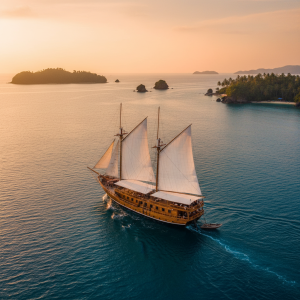
A traditional phinisi carries seven sails on two masts — three on the foremast, two on the main, and two jibs forward. The mast-stepping is itself a ceremony. Once the masts are in place, the rigging is hand-spliced from natural and synthetic line, and the sails (now usually Dacron, traditionally cotton) are hoisted for tuning.
6. Launch (annyorong lopi II)
Launch happens at high tide on a chosen auspicious date. Up to a hundred villagers gather to push the vessel down rolling logs into the sea. The owner sponsors a feast for the entire shipyard. From beach to first water typically takes nine to fourteen months for a 38m hull, eighteen months for a 45m vessel.
Why the build matters when you charter
Three things flow directly from this construction process onto the charter experience. First, every phinisi is genuinely unique — no two hulls move through water identically, no two cabins have the same proportions, no two transoms are decorated the same. Second, the boat is alive in a way that fibreglass yachts are not: timbers move slightly as the vessel heels, you hear the rigging settle, the salon smells of teak and copal varnish. Third, the maintenance regime is continuous. The crew you sail with includes carpenters who treat the vessel as their workshop. Decks are oiled weekly, planks are inspected daily, ironwood is treated against marine borers monthly. You are sailing on a working object that is being curated under your feet for the entire voyage.
The economics of phinisi shipbuilding today
A 38m phinisi commissioned in 2024 typically costs USD 600,000-900,000 to deliver to charter spec — hull, rigging, engines, AC, cabins, dive compressor, tenders. A 45m luxury phinisi runs USD 1.4-2.2 million. By yacht-build standards these are remarkably low numbers — a comparable fibreglass motor yacht to charter spec would cost three to five times more. The labour content is enormous (eighteen months of fifteen to twenty shipwrights working five-and-a-half-day weeks) but at Indonesian wage levels the build remains competitive. The hull lifespan, with proper maintenance, exceeds thirty years.
Knowing what you are stepping aboard changes the experience of being there. To plan your own voyage, see our curated private voyage page or compare destination options in the Komodo vs Raja Ampat vs Bali guide. Pricing detail is in the 2026 charter cost breakdown. Or message the atelier with your dates.
A closing reflection on craft and charter
The pinisi tradition has weathered four hundred years of trade routes, two colonial powers, the introduction of the diesel engine, and now the global luxury charter market. The yards at Tana Beru and Bira are busier today than at any point in living memory because charter demand has revived the economic logic of building wooden hulls. Walking the beach you see the future and the past simultaneously — apprentices who learned the craft from grandfathers, working alongside masters in their seventies, building boats that will sail the same waters their ancestors traded across in cloves and nutmeg. Chartering one of these vessels is a small act of cultural sustenance. The fee you pay funds the next launch ceremony, the next keel timber, the next generation of Konjo shipwrights.